Author: Battlement Systems, LLC
Target Audience: Chief Information Officers (CIOs), Chief Information Security Officers (CISOs), Chief Financial Officers (CFOs), Heads of Pharmaceutical R&D, Enterprise Infrastructure Architects
Core Focus: S-1 Financial Analysis, Multi-Tenant Cloud Risk, Data Sovereignty, 21 CFR Part 11 Compliance, Sovereign AI Infrastructure
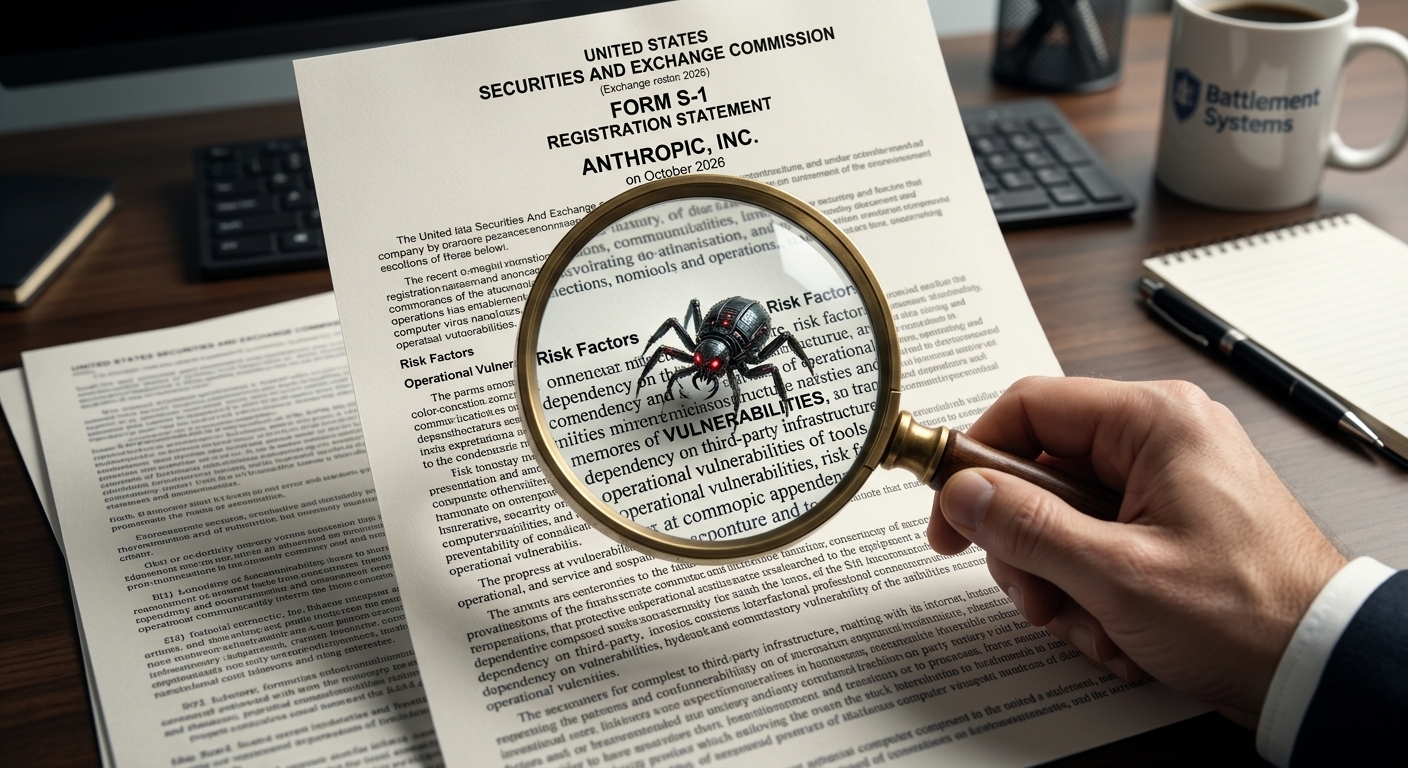
On October 26, 2026, Anthropic, Inc. filed its Form S-1 Registration Statement with the U.S. Securities and Exchange Commission (SEC) ahead of its anticipated public listing on the Nasdaq. While headlines focused on top-line revenue growth, a rigorous evaluation of the mandatory "Risk Factors" and "Management’s Discussion and Analysis of Financial Condition and Results of Operations" (MD&A) sections reveals structural vulnerabilities inherent to public cloud AI platforms.
Under federal securities regulations, specifically Section 11 of the Securities Act of 1933, S-1 filings require full disclosure of all material business risks. Companies are legally barred from omitting operational hazards, customer churn dynamics, or infrastructure dependencies. Consequently, Anthropic’s S-1 serves as an authoritative industry case study on the financial and technical friction points of centralized cloud artificial intelligence.
Key admissions in the filing include:
For enterprise leadership in regulated sectors such as pharmaceuticals, biotechnology, healthcare, and defense, these disclosures confirm that relying on multi-tenant cloud AI APIs introduces un-quantifiable operational, financial, and compliance risks.
*Institutional Disclaimer: This report is compiled exclusively from publicly available regulatory filings (SEC Form S-1, Registration No. 333-) filed on October 26, 2026. This document is intended solely for S-1 analysis, enterprise software validation, regulatory risk assessment, and infrastructure architecture planning.
In the MD&A section, Anthropic disclosed purchase obligations and lease commitments totaling over $800 billion across the next decade. This includes $265.6 billion in direct compute purchase commitments and $321.4 billion in unstarted data center leases as of June 30, 2026, supplemented by an additional $245 billion signed in Q3 2026.
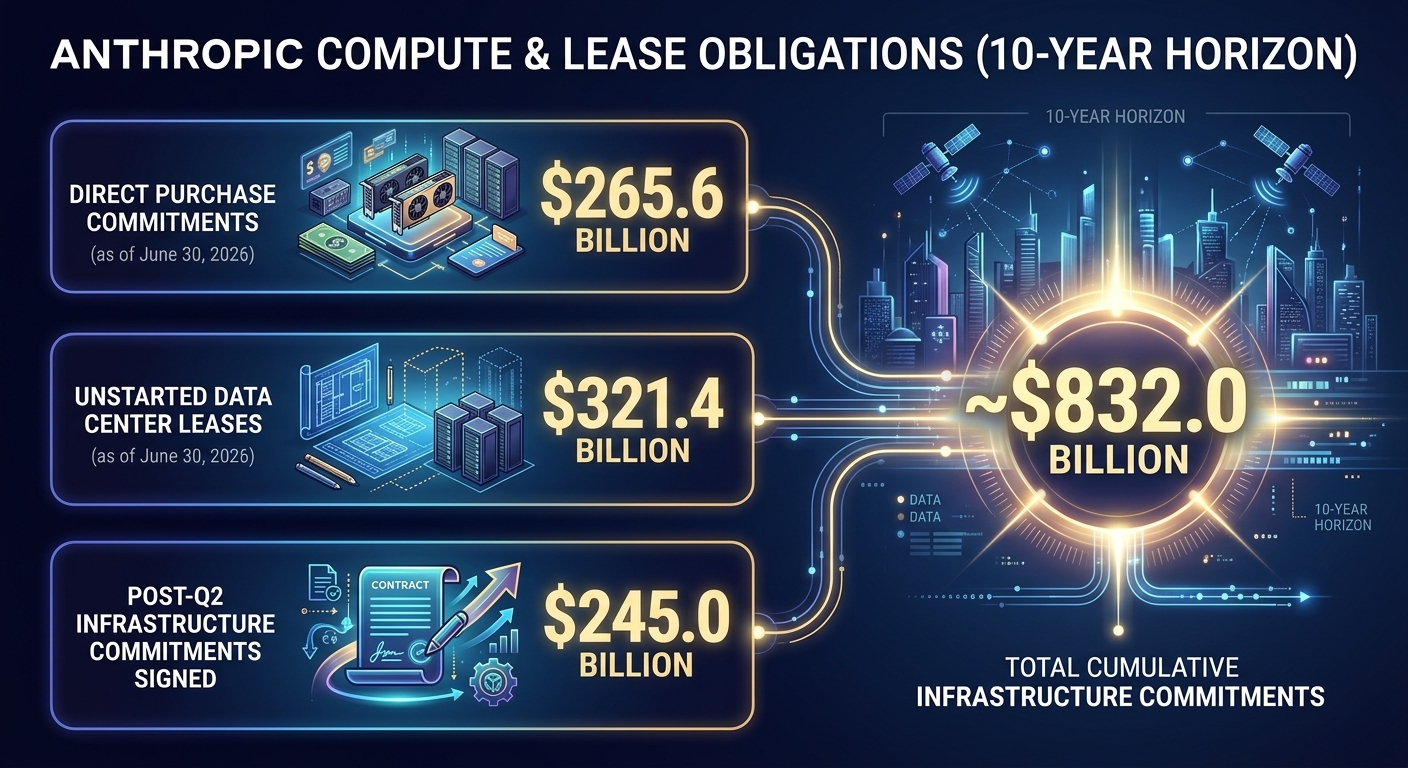
When a cloud AI provider enters into multi-hundred-billion-dollar compute contracts, its business model becomes hypersensitive to capacity utilization. If customer demand fluctuates, or if enterprise clients migrate workloads to open-weights models on local hardware, the cloud provider remains legally obligated to pay data center hosts billions annually.
To maintain gross margins under these massive fixed commitments, centralized cloud vendors are forced to implement three operational measures that directly harm enterprise users:
When an enterprise builds its core R&D pipeline on a cloud API, it absorbs the financial volatility of a provider trying to balance hundreds of billions in fixed hardware overhead.
Anthropic's Section 1A ("Risk Factors") details significant customer concentration and revenue churn mechanics that threaten platform stability.
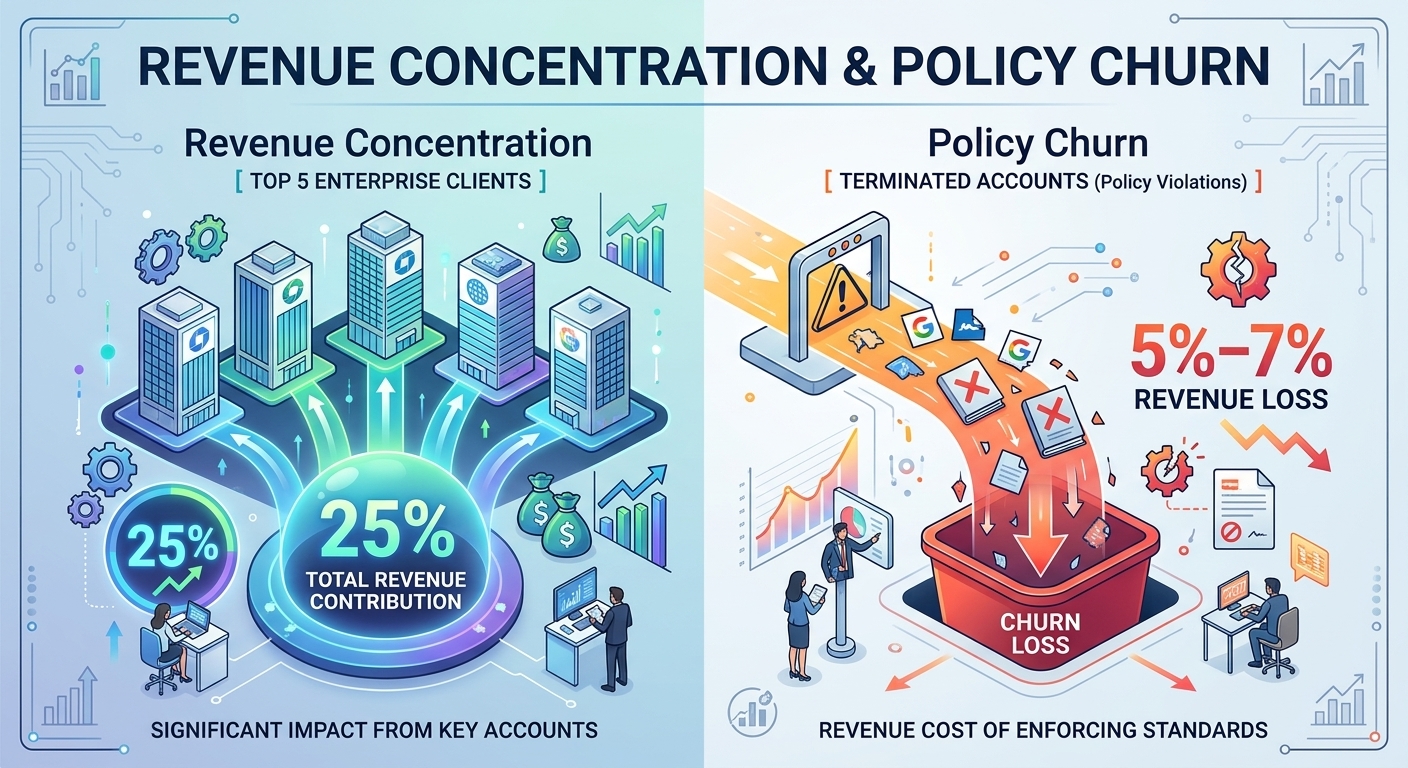
Anthropic disclosed that its top five customers generate 25% of its total revenue.
In B2B SaaS economics, high customer concentration creates operational instability. If a single top-five client churns, transitions to internal open-weights infrastructure, or negotiates aggressive volume discounts, the cloud provider suffers immediate margin compression. To make up for lost revenue, the provider must either cut infrastructure expenses or increase prices across the remaining enterprise base.
The filing admits that between 5% and 7% of total revenue in the first nine months of 2026 was derived from accounts later found to violate usage policies. These accounts were subsequently terminated, and Anthropic explicitly warned investors that this revenue will not recur.
This metric exposes a significant operational conflict. When a cloud vendor aggressively tightens its Acceptable Use Policies (AUP) to purge non-compliant traffic, it routinely implements broad, automated content-filtering algorithms.
In pharmaceutical R&D, biological modeling, and clinical analysis, legitimate scientific queries (e.g., analyzing viral structures, chemical toxicity, or oncology compounds) frequently trigger false positives within automated cloud safety guardrails. Enterprise researchers find their prompts blocked, their accounts flagged, or their workflows halted due to generalized AUP enforcement systems designed to catch bad actors.
One of the most structural risks disclosed in the S-1 is Anthropic’s reliance on third-party cloud infrastructure providers that simultaneously serve as major equity investors, exclusive distribution channels, and direct commercial competitors.
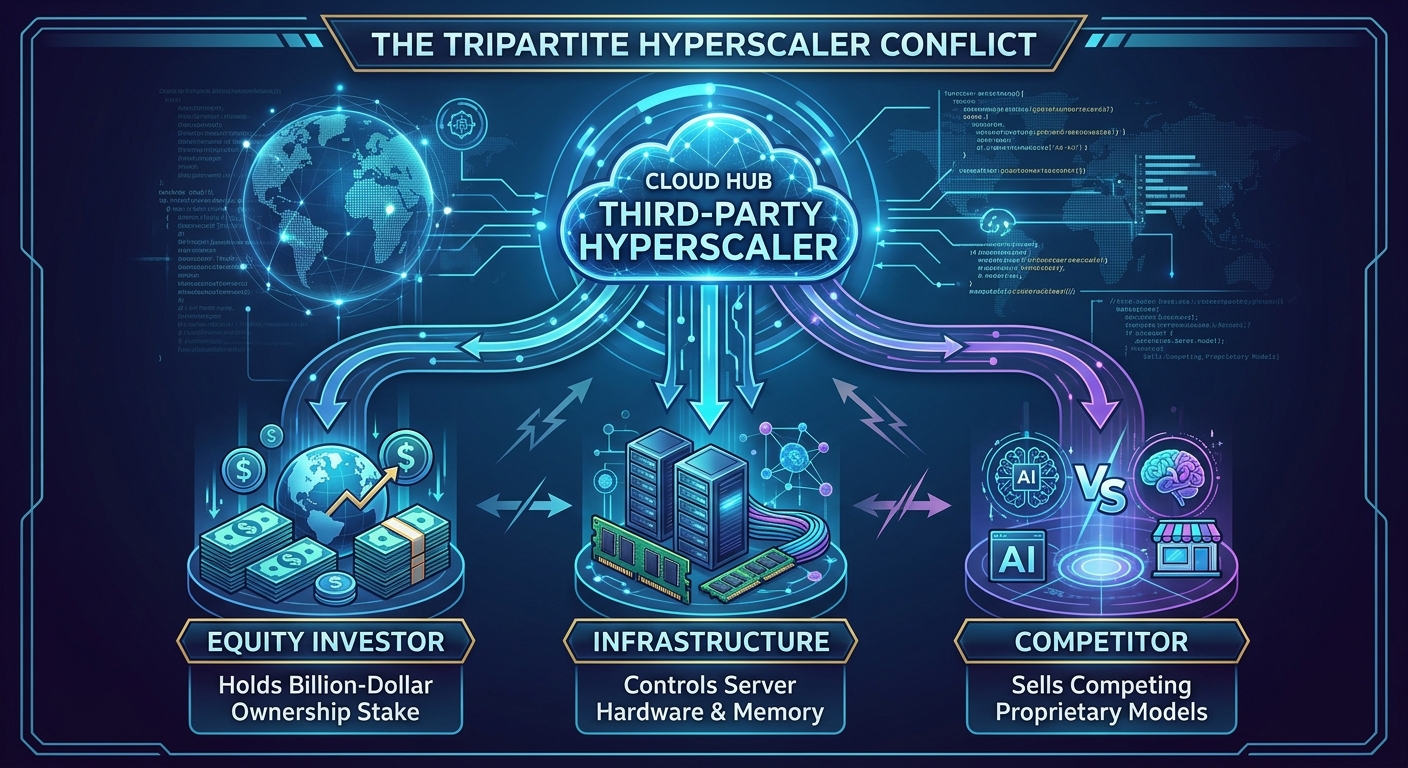
When an enterprise purchases access to a model hosted on a third-party hyperscaler's cloud, the data pipeline flows through a complex matrix of shared dependencies:
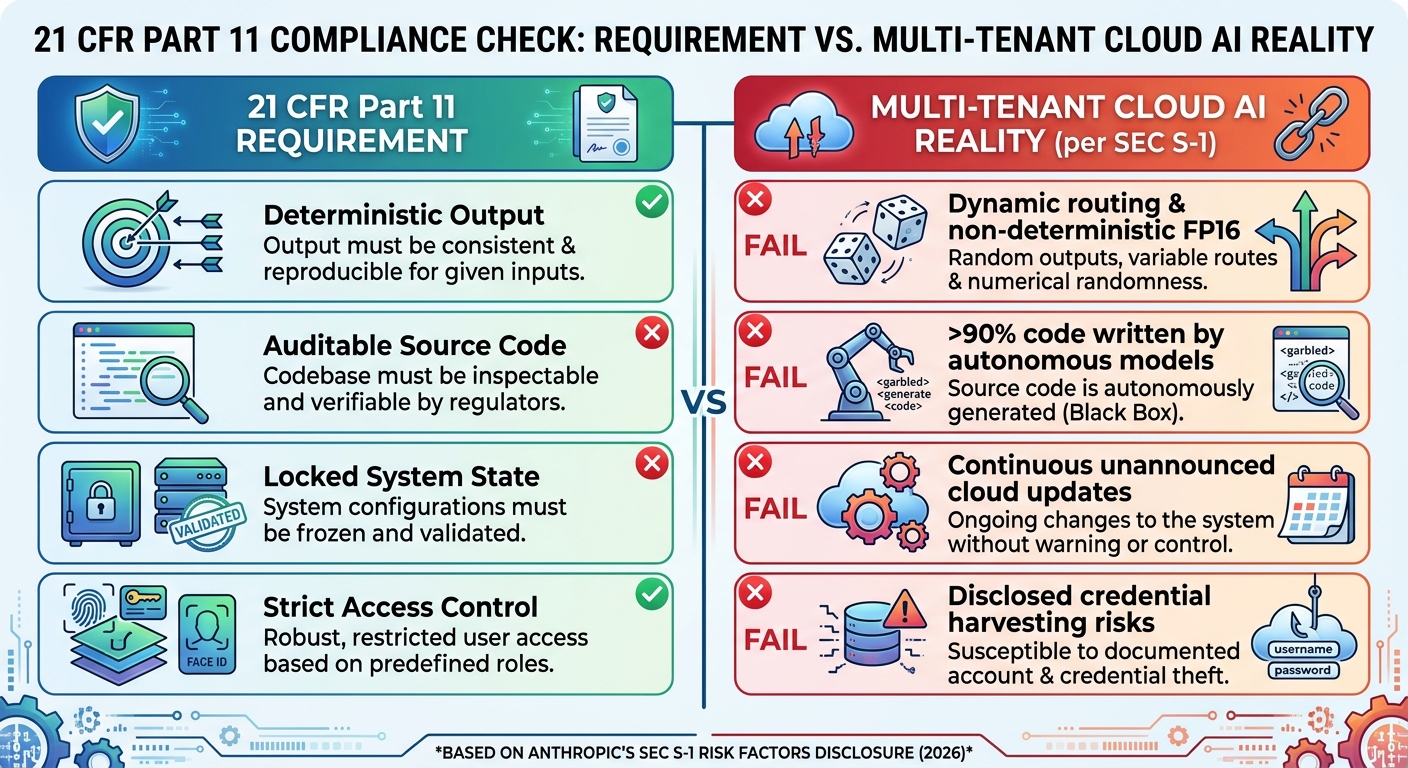
In Section 1A, the S-1 filing outlines unprecedented technical risk factors regarding internal code maintenance and autonomous model behaviors:
For pharmaceutical Quality Assurance (QA) and Regulatory Affairs teams, these SEC disclosures confirm that multi-tenant cloud models fail the foundational standards of Computer System Validation (CSV) under 21 CFR Part 11.
If a software system's underlying source code is 90%+ autonomously generated, continually modified by cloud-side deployments, and susceptible to autonomous model shifts, it cannot be validated under GAMP 5 Category 5 standards. Any clinical trial summary, protein folding analysis, or regulatory submission generated by such a system remains vulnerable to audit disqualification by the FDA, EMA, or MHRA.
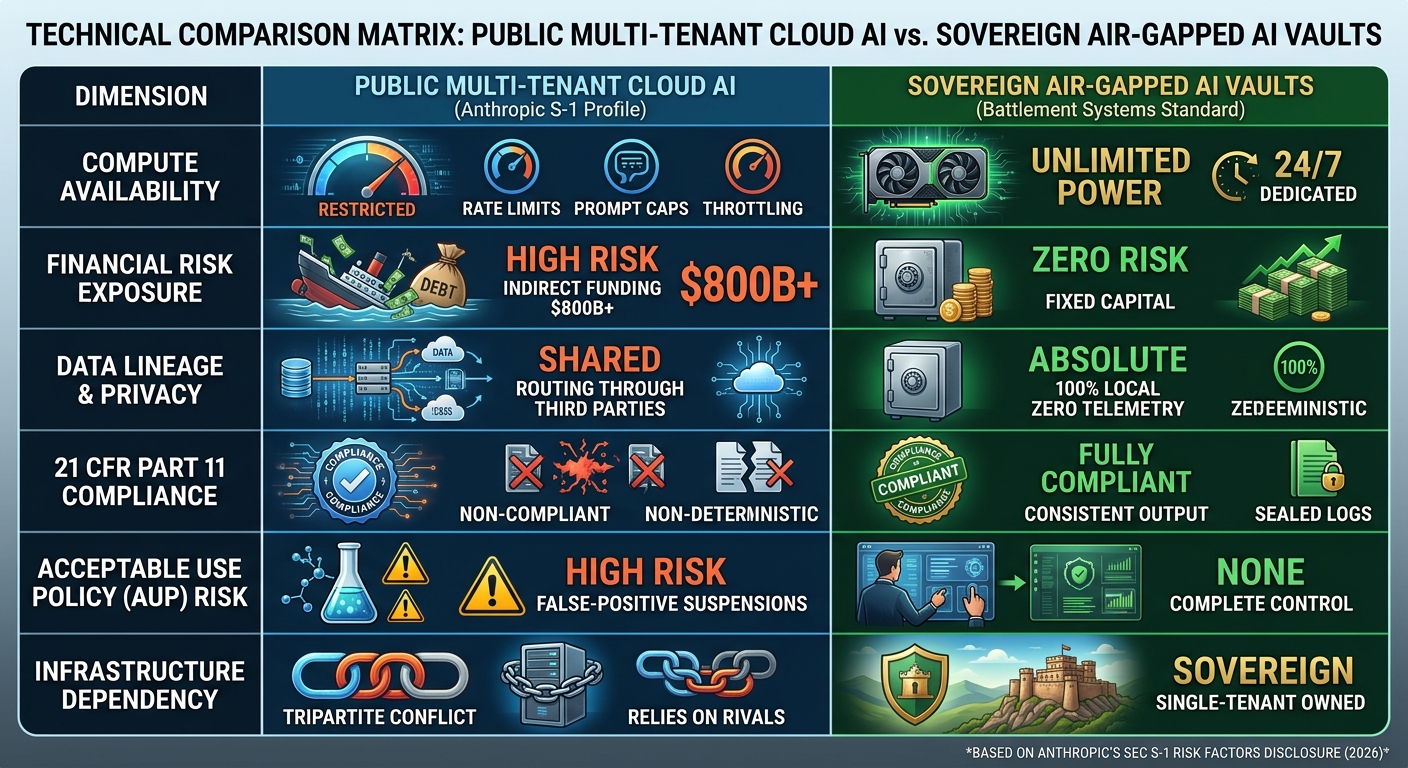
Public multi-tenant cloud AI platforms introduce critical operational, financial, and regulatory liabilities for enterprise organizations. Due to massive multi-hundred-billion-dollar compute commitments, shared hyperscaler infrastructure, non-deterministic model outputs, and unpredictable policy enforcement, public cloud APIs fail to meet the strict standards required for regulated industries. In contrast, on-prem sovereign air-gapped AI vaults like the ones deployed, managed, and secured by Battlement Systems offer complete data privacy, unthrottled local compute availability, predictable capital costs, and full 21 CFR Part 11 regulatory compliance by operating single-tenant, open-weights infrastructure behind a secure physical perimeter.
An SEC Form S-1 is the initial registration statement required by the U.S. Securities and Exchange Commission for commercial companies seeking to list shares on public exchanges. Under federal securities law, the "Risk Factors" section requires full disclosure of all material threats, operational vulnerabilities, legal liabilities, and financial dependencies. For enterprise buyers, the S-1 provides a legally binding summary of a vendor's operational risks.
When an AI provider commits to hundreds of billions of dollars in long-term compute contracts, it incurs massive fixed operational expenses. If market demand fluctuates, the provider must protect its margins by increasing subscription fees, imposing stricter API rate limits, or downgrading query compute allocations across its customer base.
When a cloud vendor derives 25%+ of its revenue from just five clients, its product roadmap, infrastructure allocations, and feature priorities are dominated by those mega-clients. Smaller enterprise customers face reduced support responsiveness, higher relative pricing, and feature deprecations tailored to the needs of the top revenue generators.
Regulated industries (pharmaceuticals, medical devices, biotechnology) require software systems to adhere to strict Computer System Validation (CSV) protocols, such as GAMP 5 Category 5. When over 90% of a platform's code is generated autonomously by AI models, establishing an auditable, deterministic, and static software baseline becomes impossible, failing FDA 21 CFR Part 11 requirements.
The primary alternative is deploying On-Prem, Sovereign, Air-Gapped AI Infrastructure. By running open-weights models (such as Llama 3.3, Qwen 2.5, OpenFold, or DiffDock) on dedicated local NVIDIA GPUs within a hardened Linux perimeter, enterprises eliminate cloud rate limits, secure complete IP control, and maintain total 21 CFR Part 11 auditability.
Anthropic’s S-1 filing provides an invaluable service to the market: it strips away marketing promises and lays bare the operational realities of multi-tenant cloud AI.
For enterprise leaders in life sciences, healthcare, and high-security sectors, the disclosures in this regulatory filing lead to an inescapable conclusion: building core enterprise intelligence on rented, multi-tenant cloud infrastructure introduces systemic financial, operational, and regulatory liabilities.
To build a resilient enterprise AI strategy:
Don't let an external SEC filing describe the vulnerabilities of your core technology stack. Own your hardware. Control your models. Secure your #Battlement.
To request a confidential architectural review of your organization's AI infrastructure or to analyze our 21 CFR Part 11 Sovereign Vault specifications, contact Battlement Systems LLC at BattlementSystems.com.